Long Lake NWR
Prairie Pothole Region
NWRNational Wildlife RefugePeak windowVerified coordinates
Top birds: Sandhill Crane, Whooping Crane, American Avocet, Wilson's Phalarope
Free; special-use permit may be needed for temporary blinds
Cranes · Fall migration in September
Live observation
Recent North Dakota reports from eBird, closest first from Bismarck (the default starting point).
These are observations submitted by birders and are not reviewed before appearing here. A report is not a guarantee that the bird is still present, and a sighting location is not a public-access guarantee.
Recent sightings data from eBird, Cornell Lab of Ornithology. Sunrise, sunset and sun direction: calculated on your device from the location's coordinates.
S = spring window, F = fall window, B = both. Built from the month arrays in the source record; months are January (1) through December (12).
Planning guidance from this bird's own seasonal record, not a live report. Weather shifts these dates every year, sometimes by a fortnight.
Migration journey reference: National Audubon Society Bird Migration Explorer.
See the full journey on Audubon's Bird Migration ExplorerAransas to Wood Buffalo flyway: central ND, curving northwest along the Missouri Coteau to the ND-Saskatchewan border (the 95% corridor covers about 64% of ND)
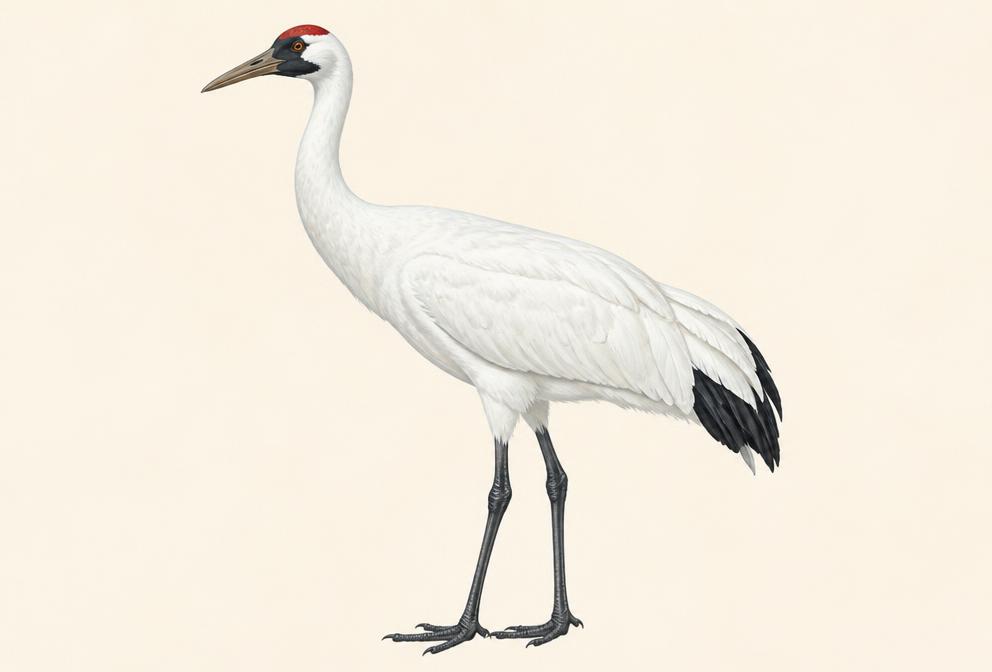
A rare, luck-based sighting. Five feet tall, white with black wingtips, neck extended in flight (pelicans tuck their necks; don't confuse). Do not disturb; report date, time, location, activity, and leg bands to USFWS Lostwood (701-848-2466), Long Lake (701-387-4397), or ND Game and Fish (701-328-6300).
Rare and federally protected
Wildlife safeguards
Each place shows what eBird received within 10 miles of that place in the last 7 days. Reports further away belong to somewhere else and are never counted here.
Prairie Pothole Region
Top birds: Sandhill Crane, Whooping Crane, American Avocet, Wilson's Phalarope
Free; special-use permit may be needed for temporary blinds
Prairie Pothole Region
Top birds: Whooping Crane, Western Meadowlark
Free
Recent sightings data from eBird, Cornell Lab of Ornithology.
Recent sightings data from eBird, Cornell Lab of Ornithology.
These are historical public posts collected as supporting evidence. They are not live sightings and do not guarantee current bird activity. Photos are not copied here — each entry links to the original post.
March 2026 — Whooping Crane
Pair, courtship dance; 'WHOOP! There it is!'
ND ag field(free text only — no mapped place, so no map pin)
Open source poston Facebook (opens in a new tab; older posts may have been removed by their author)2026-04-06 — Whooping Crane
14 in marshes (about 2.5% of the world population)
Burleigh/Emmons County marshes(free text only — no mapped place, so no map pin)
Open source poston Instagram (opens in a new tab; older posts may have been removed by their author)2026-04-13 — Whooping Crane
3, multi-day observation
Near NDSU Central Grasslands REC, ND(free text only — no mapped place, so no map pin)
Open source poston Facebook (opens in a new tab; older posts may have been removed by their author)2025-10-13 — Whooping Crane
V-formation over cornfield; October arrivals
ND(free text only — no mapped place, so no map pin)
Open source poston Instagram (opens in a new tab; older posts may have been removed by their author)